This Week in AI: Karpathy Joins Anthropic, Self-Hosted Sandboxes, and HTML Kills Markdown
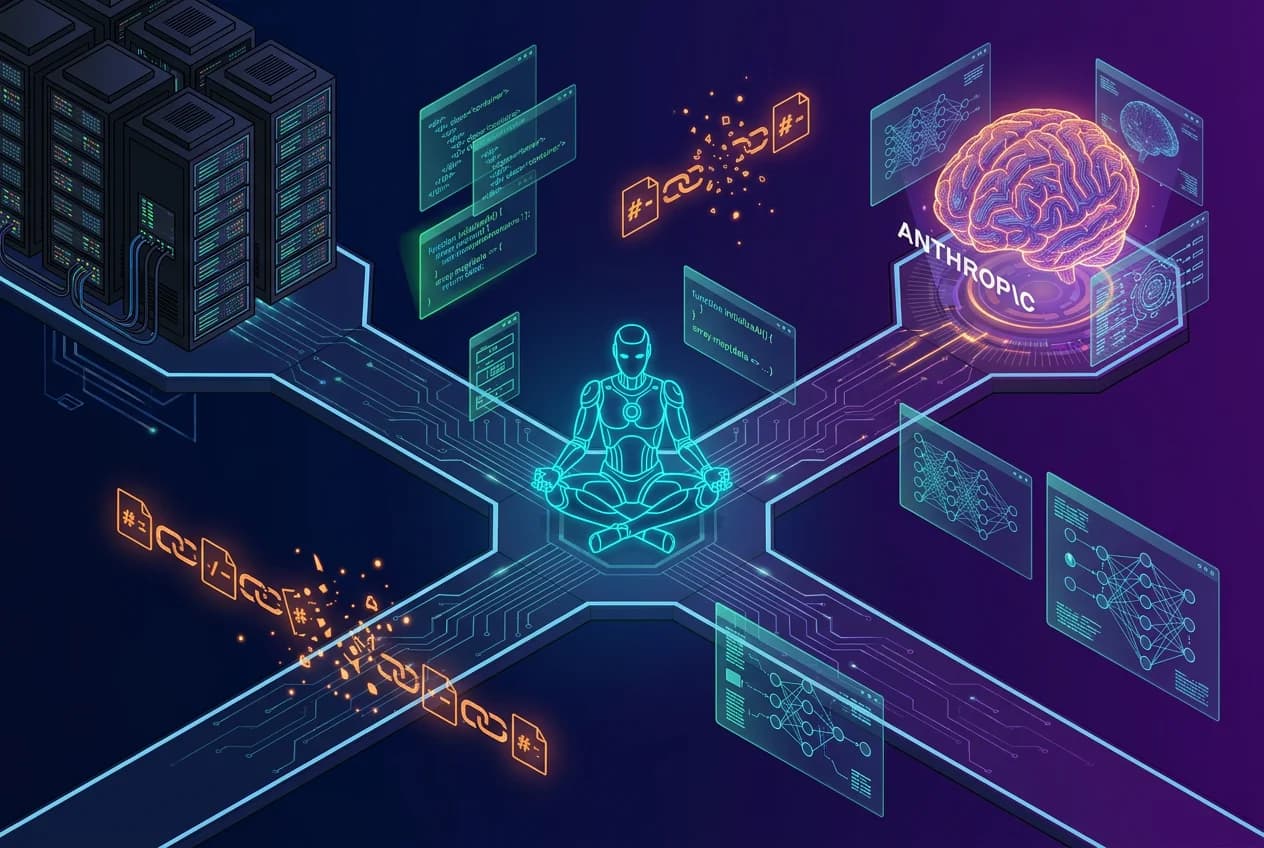
Karpathy joins Anthropic, Claude gets self-hosted sandboxes, and HTML replaces markdown for AI-generated output.
6 min read · 1,140 words
This Week in AI: Karpathy Joins Anthropic, Self-Hosted Sandboxes, and HTML Kills Markdown
Three things happened in the last 72 hours that will reshape how we build with AI. One man moved from OpenAI to Anthropic. One product split the AI brain from the AI hands. And one format war declared a winner.
If you blinked, you missed the week that mattered.
Karpathy Just Changed Sides
Andrej Karpathy — OpenAI co-founder, Tesla's former AI director, the man whose YouTube lectures taught half the field how transformers work — posted seven sentences on X on Tuesday morning.
The first one read: "Personal update: I've joined Anthropic."
He's working on the pre-training team under Nick Joseph. His mandate: build a new group that uses Claude to accelerate the training of the next generation of Claude. He paused Eureka Labs for this. He's not dabbling.
Here's the number that makes this strategic, not sentimental: Anthropic is reportedly closing a funding round at a roughly $900 billion valuation. That would put Anthropic above OpenAI in private markets for the first time.
Karpathy didn't just leave one company for another. He left the company that's losing the valuation race to join the company that's winning it. That's not a career move. That's a bet.
The real play is what he'll build. "Using Claude to accelerate pre-training research" means automating the most expensive, compute-intensive phase of building a frontier model. If Karpathy's team cracks even marginal efficiency gains, Anthropic's training costs drop while everyone else's stay flat. That's the kind of flywheel that compounds.
Continue Reading
The Day Anthropic Split the Brain From the Hands
On May 19, from the stage of Code with Claude London, Anthropic announced two features that change the enterprise AI conversation entirely: self-hosted sandboxes (public beta) and MCP tunnels (research preview).
Here's what landed:
Self-hosted sandboxes mean your files never leave your infrastructure. The agent loop — the part that decides what to do next — stays on Anthropic's servers. But the moment the model says "read this file" or "run this command," that execution happens in a container inside your perimeter. Your network policies, your audit logging, your security tools. The file content never transits to Anthropic.
Four managed providers launched day one: Cloudflare (microVMs, millisecond startups), Daytona (SSH-accessible, stateful, pause/resume), Modal (GPU-optimized for AI workloads), and Vercel (VM security with VPC peering). Or bring your own.
MCP tunnels are the sleeper feature. A deployed gateway establishes a single outbound connection to your internal services. No inbound firewall rules. No public endpoints. End-to-end encrypted. Your databases, private APIs, and knowledge bases become agent tools without ever touching the public internet.
The architecture is clean: intelligence on Anthropic, execution on your infra. But here's the caveat nobody's naming — the orchestration layer, the part that actually decides what your agent does, stays on Anthropic's servers. A fully on-premise deployment isn't possible. Your data stays local during tool execution. Your agent's cognitive loop does not.
That's a trade-off worth understanding before you bet a production pipeline on it.
Meanwhile, BerriAI open-sourced the LiteLLM Agent Platform — a Kubernetes-based self-hosted infrastructure for running multiple isolated agent sandboxes with session continuity. And Containarium launched as an MCP-native sandbox that spins up lightweight containers in milliseconds.
The self-hosted agent infrastructure space went from "doesn't exist" to "four options plus open source" in a single week.
HTML Just Killed Markdown
On May 8, Thariq Shihipar — a member of the Claude Code team at Anthropic — posted what became one of the most-discussed dev takes of the quarter:
"HTML is the new markdown. I've stopped writing markdown files for almost everything and switched to using Claude Code to generate HTML for me."
Karpathy retweeted it. The post hit tens of millions of views in 48 hours.
Shihipar's argument was concrete. HTML lets Claude do things markdown simply can't:
- Inline SVG diagrams instead of fenced ASCII art
- Interactive widgets — sliders, toggles, collapsible sections — so a PR review becomes a navigable artifact instead of a wall of text
- In-page navigation, color-coded severity, real layout
- Semantic structure the model can hang richer reasoning on
The rebuttal landed fast. Kurtis Redux pointed out three problems:
- HTML is 2-4x slower to generate than the markdown equivalent
- Verbose markup dilutes model attention — longer output means more chances to hallucinate structure
- Output tokens are the expensive tokens — 3-5x the cost of input across every major API
Recommending 2-4x more output tokens is a real line item on your API bill.
But here's what both sides missed. The debate framed it as binary: rich-but-expensive HTML vs. cheap-but-flat markdown. That framing is wrong.
The real insight came from the three-layer model:
Layer 1: Protocol layer — AI-to-AI communication. CLAUDE.md, AGENTS.md, instruction files. This stays Markdown forever. It's the HTTP of agent systems. Nobody reads it directly.
Layer 2: Interface layer — AI-to-human output. Specification reports, PR interpretations, design explorations. This migrates to HTML. Information density, readability, sharing, interaction.
Layer 3: Tool layer — Disposable custom UIs. AI generates a throwaway HTML interface with sliders and toggles for a specific decision, you interact with it, copy the result back. This layer didn't exist before AI.
Markdown didn't die. It retreated to the protocol layer and became more deeply rooted. HTML took over the interface layer. And the tool layer is genuinely new.
The data backs this up. Cloudflare's "Markdown for Agents" showed HTML-to-Markdown conversion cuts tokens by 80% (16,180 → 3,150 tokens). HtmlRAG from WWW 2025 demonstrated that pruned HTML outperforms Markdown for retrieval accuracy. And Microsoft Research found HTML beats Markdown by 28 points on column retrieval in table QA tasks.
The format war isn't about which is "better." It's about which layer you're building for.
What This Week Actually Means
Karpathy's move signals that the AI talent war has crossed a threshold. When the man who taught the world about transformers leaves OpenAI for Anthropic, it's not about salary or title. It's about where the most important work happens next.
Self-hosted sandboxes mean the enterprise "but where does my data go" objection just lost its strongest argument. The architecture isn't perfect — orchestration stays remote — but for most regulated industries, tool execution staying local is the 80/20 solution.
And the HTML shift? It's the first sign that AI-native development isn't just about better prompts or bigger models. It's about fundamentally different output formats. The terminal is becoming a platform. The document is becoming an application.
The next 90 days will be the most competitive window in AI history. Karpathy is building Claude's brain at a company worth more than OpenAI. Anthropic just gave enterprises a way to run agents on their own infrastructure. And the way AI delivers information to humans changed format.
If you're still writing markdown files for AI output, you're building for the protocol layer. The interface layer has moved on.
Published May 20, 2026 — Covering Anthropic, Karpathy, self-hosted sandboxes, and the HTML vs. markdown shift through May 20, 2026.

Bashar Ayyash (Yabasha)
AI Systems Architect for regulated industries — evals, harness design, AI security.
Bashar Ayyash is an AI engineer and dev lead in Amman, Jordan. 20 years shipping software, 4 years inside a regulated bank building production RAG and agent systems with evals, guardrails and monitoring — in Arabic and English. He writes at yabasha.dev and builds open-source tooling for AI-assisted development.
Newsletter
Practical AI + full-stack insights for MENA builders. No spam.
Related Articles

Findable Is Not Chosen — and That Résumé Won't Save You

The $18K Ceiling Breaker: Skills That Actually Move Your Number

Why My AI Prompts Are 12 Words Long — And Yours Should Collapse Too
The Tailwind Tsunami: How a CSS Framework's Collapse Signals the End of Software Development as We Knew It
Read more on the blog
Browse the latest articles or explore the full archive.