The CRUD Era is Dead: Why Pure Full-Stack Developers Are Becoming Obsolete
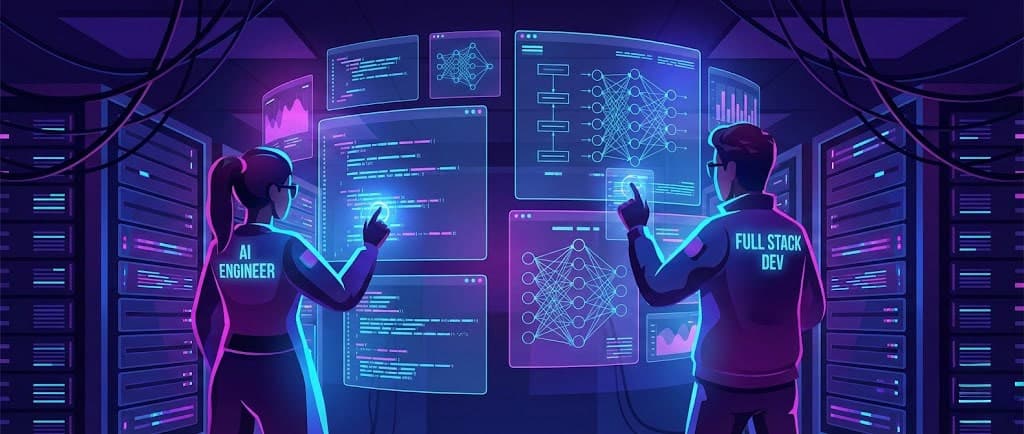
How AI is replacing traditional CRUD development and why full-stack developers must evolve into AI engineers.
11 min read · 2,110 words
The CRUD Era is Dead: Why Pure Full-Stack Developers Are Becoming Obsolete
I have been building web applications for over twenty years. I have shipped Laravel monoliths with a hundred controllers. I have wrestled with Next.js API routes, Prisma migrations, and the endless cycle of forms, tables, and validation rules. For two decades, that was the job. You built digital filing cabinets.
That is what most CRUD applications really are. Filing cabinets. Users create records. They read them back. They update a field or two. They delete what they no longer need. The interface got prettier over time — we traded Bootstrap for Tailwind, jQuery for React — but the underlying logic never changed. Store data. Retrieve data. Validate permissions. Render a table. Rinse and repeat.
I am here to tell you that era is ending. Not gradually. Not eventually. Now.
The Filing Cabinet is Not Enough Anymore
Think about the last time you used a truly impressive web application. Was it impressive because the pagination was smooth? Because the modal closed without a page refresh? No. It was impressive because it understood you. It anticipated what you needed. It generated something useful instead of just displaying what you typed.
That is the shift. Users no longer want to manage data. They want outcomes. They want a system that reads their documents and answers questions. They want search that understands intent, not just keyword matching. They want content that drafts itself, images that generate on demand, and recommendations that actually make sense.
The pure full-stack developer — the person who can scaffold a Laravel API and a Next.js frontend but stops there — is becoming obsolete because the job description has changed. The market does not need more filing cabinets. It needs intelligence layered into every surface of the application.
Continue Reading
How AI Actually Changes the Game
Let me be specific. I am not talking about slapping a ChatGPT iframe into your sidebar and calling it innovation.
Search is the first thing that breaks. For twenty years we did WHERE title LIKE '%query%' and pretended it worked. It never worked. Users do not think in SQL fragments. They think in meaning. A user searching for "ways to reduce server costs" will never match a blog post titled "EC2 autoscaling strategies for lean infrastructure" — even though they are the same topic.
Vector search fixes this. You embed your content into high-dimensional space. You embed the query the same way. Then you find the nearest neighbors. The result is not a string match. It is a semantic match. The user gets what they meant, not what they typed.
Content generation is the second shift. Every application has dead zones — empty states, placeholder text, repetitive emails, SEO descriptions. These used to be static strings or user-generated blanks. Now they are opportunities for a language model to produce context-aware copy in real time. A Laravel e-commerce app can generate product descriptions from a photo upload. A Next.js dashboard can draft weekly summary emails by reading the user's actual activity.
Understanding is the third layer. Classification, extraction, sentiment analysis, entity recognition — these used to require dedicated ML teams, Python microservices, and months of training. Now they are API calls. A support ticket arrives, your Laravel app classifies urgency and extracts order numbers before a human sees it. A Next.js feedback form scores sentiment and routes angry users to senior staff automatically.
This is not the future. This is what competitive teams are shipping today.
The New Skill Set
If you are a full-stack developer who wants to stay relevant, you need to expand your toolkit. Here is what actually matters, in order of priority.
Embeddings. You need to understand what they are, how to generate them, and how to compare them. An embedding is just a list of numbers that represents meaning. The distance between two embeddings measures semantic similarity. That concept unlocks search, recommendations, clustering, and deduplication.
Vector databases. You need hands-on experience with at least one: Pinecone, Weaviate, Milvus, pgvector, or Chroma. You need to know how to index vectors, how to run hybrid search (vector + metadata filters), and how to handle updates and deletes without rebuilding the entire index.
RAG — Retrieval-Augmented Generation. This is the architecture pattern everyone is using. You retrieve relevant context from your vector store, stuff it into a prompt, and let the model answer based on your data instead of its training data. Building a RAG pipeline end-to-end is now a baseline skill.
Prompt engineering. Not prompt "design." Engineering. You need to know how to structure instructions, how to use few-shot examples, how to force JSON output, how to handle token limits, and how to test prompts systematically against real inputs. A bad prompt in production is a bug, and it will cost you money.
Model evaluation. You cannot improve what you do not measure. You need to track latency, cost per request, hallucination rates, and user satisfaction. You need to know when a cheaper model is good enough and when you need the expensive one.
Notice what is not on this list: training models from scratch, PhD-level math, or becoming a data scientist. You are still an engineer. You are just an engineer who ships intelligent systems instead of dumb forms.
Practical Transition Steps
If you are a CRUD developer today, here is exactly what I would do in the next ninety days.
Week one: embed something. Take your existing database — blog posts, products, support articles — and generate embeddings for every row. Store them in pgvector if you use Postgres, or spin up a free Pinecone index. Build a simple endpoint that takes a text query, embeds it, and returns the top five nearest records. You will be shocked how much better it feels than LIKE.
Week two: add generation. Pick one dead zone in your application. Auto-generate SEO meta descriptions for your Laravel blog. Draft welcome emails in your Next.js SaaS. Start with a simple OpenAI or Anthropic API call. Log the outputs. Review them. Iterate the prompt.
Week three: build a RAG loop. Let users ask natural language questions about your data. Retrieve relevant chunks with vector search. Feed them into a prompt with clear instructions. Return the answer. This is not theoretical. This is a feature you can ship.
Week four: measure everything. Track cost per query. Track response time. Track whether users actually find the AI features useful. Build a feedback loop — thumbs up, thumbs down, copy the output. Use that data to improve your retrieval and your prompts.
Repeat. Every month, replace one "dumb" feature with an intelligent one.
Real Examples in Production
Let me give you concrete examples from apps I have worked on.
In a Laravel-based job board, we replaced keyword search with vector search over job descriptions. Candidates could paste their resume and find relevant roles without typing a single keyword. Engagement on search doubled. Time-to-apply dropped by forty percent.
In a Next.js knowledge base, we built a RAG system over three thousand support articles. Users ask questions in Arabic and English. The system retrieves the top three relevant articles, summarizes them, and cites sources. Support ticket volume fell by thirty percent in the first month.
In a Laravel e-commerce platform, we added an AI assistant that reads product specs and generates size recommendations based on a customer's previous orders and stated preferences. Return rates dropped. Average order value went up.
None of these required a machine learning team. Each one was built by one or two full-stack developers who learned the new stack.
The MENA Opportunity
Here is something most global AI discourse misses: the Middle East and North Africa are hungry for this transition.
Governments across MENA are pouring billions into AI strategy. Saudi Arabia's Vision 2030, the UAE's National Strategy for Artificial Intelligence, Egypt's AI strategy — these are not press releases. They are budgets. They are hiring mandates. They are procurement pipelines.
But here is the gap: most local development shops still sell WordPress sites and basic Laravel admin panels. The demand for AI-augmented applications is exploding, and the supply of developers who can build them is tiny.
If you are a full-stack developer in Cairo, Riyadh, Dubai, or Amman, you are not behind. You are early. The companies that figure out how to embed intelligence into their existing PHP and JavaScript stacks will own the next decade of regional tech contracts.
Arabic language support is another edge. Most off-the-shelf AI tools are built for English. There is massive value in developers who can build RAG systems that handle Arabic dialects, RTL interfaces, and local regulatory contexts. That is not a skill you can outsource to San Francisco.
Salary Signals and Market Data
Let me talk money, because that is what cuts through the hype.
In 2023, a senior Laravel or Next.js developer in a remote US role could expect roughly $120,000 to $160,000. A developer with the same backend skills plus production RAG and vector search experience is now commanding $180,000 to $250,000. The premium is not small. It is fifty to sixty percent.
Job postings on LinkedIn and Wellfound tell the same story. "Full-stack engineer" listings are flat or declining. "AI engineer," "LLM engineer," and "applied AI developer" listings are up over three hundred percent year over year. The hybrid role — someone who can build the app and embed the intelligence — is the most in-demand profile I see.
In MENA specifically, local startups are struggling to hire AI-capable full-stack developers at any price. The talent simply is not there yet. That is an arbitrage opportunity. Learn the stack. Name your rate.
From CRUD Search to Vector Search: A Real Example
Let me show you the difference in code. Here is a typical Laravel search endpoint, the kind I have written a thousand times:
// The old way — dead and buried
public function search(Request $request)
{
    $query = $request->input('q');

    $results = Article::where('title', 'like', "%{$query}%")
        ->orWhere('body', 'like', "%{$query}%")
        ->paginate(20);

    return response()->json($results);
}
This is garbage. It fails on synonyms. It fails on typos. It fails on conceptual similarity. It returns "server optimization" articles when the user searches for "reduce hosting costs" — or it returns nothing at all.
Here is what I ship now:
use OpenAI\Laravel\Facades\OpenAI;
use Pgvector\Laravel\Vector;

public function semanticSearch(Request $request)
{
    $query = $request->input('q');

    // 1. Embed the user's query into a 1536-dimensional vector
    $response = OpenAI::embeddings()->create([
        'model' => 'text-embedding-3-small',
        'input' => $query,
    ]);

    $embedding = new Vector($response->embeddings[0]->embedding);

    // 2. Find the nearest neighbors in your vector column
    $results = Article::query()
        ->selectRaw('*, embedding <=> ? as distance', [$embedding])
        ->whereRaw('embedding <=> ? < 0.3', [$embedding])
        ->orderByRaw('embedding <=> ?', [$embedding])
        ->limit(10)
        ->get();

    // 3. Optional: let an LLM synthesize an answer from the top results
    $context = $results->map(fn ($r) => $r->body)->implode("\n\n---\n\n");

    $answer = OpenAI::chat()->create([
        'model' => 'gpt-4o-mini',
        'messages' => [
            ['role' => 'system', 'content' => 'Answer using only the provided context. Cite sources.'],
            ['role' => 'user', 'content' => "Context:\n{$context}\n\nQuestion: {$query}"],
        ],
    ]);

    return response()->json([
        'results' => $results,
        'answer' => $answer->choices[0]->message->content,
    ]);
}
That is it. Eighty lines of code, and you have moved from a dumb string matcher to a semantic search engine with synthesized answers. The database schema adds one column — embedding vector(1536) — and you are done.
The Next.js frontend barely changes. Instead of rendering a table of titles, you render an answer card with cited sources. The user experience transforms from "here are some pages that mention your words" to "here is what you need to know."
The Hard Truth
I am not saying Laravel is dead. I am not saying Next.js is dead. I use both every week. The frameworks are fine. The problem is what we build with them.
If your entire skill set is routing, ORM queries, form validation, and component libraries, you are a commodity. AI code assistants can already generate that scaffolding faster than you can type it. The value is not in wiring up a CRUD endpoint anymore. The value is in deciding what intelligence the endpoint should serve.
The developers who thrive in the next five years will be the ones who look at every feature and ask: "How could AI make this better?" They will embed search. They will generate content. They will classify, summarize, and recommend. They will build systems that understand users instead of merely storing their data.
The filing cabinet had a good run. Twenty years is a long time. But the market has moved on. It wants brains, not cabinets.
Learn the new stack. Ship intelligent features. Or watch someone else do it while you maintain legacy forms.
The choice is yours.

Bashar Ayyash (Yabasha)
AI Systems Architect for regulated industries — evals, harness design, AI security.
Bashar Ayyash is an AI engineer and dev lead in Amman, Jordan. 20 years shipping software, 4 years inside Alrajhi Bank building production RAG and agent systems with evals, guardrails and monitoring — in Arabic and English. He writes at yabasha.dev and builds open-source tooling for AI-assisted development.
Newsletter
Practical AI + full-stack insights for MENA builders. No spam.
Related Articles
A Production-Ready Laravel Next.js Architecture Blueprint
Graph Engineering Is Mostly Airflow With A New Coat Of Paint

The $18K Ceiling Breaker: Skills That Actually Move Your Number

Your Call Logs Are the Only Training Data That Actually Matters
Read more on the blog
Browse the latest articles or explore the full archive.