The Tailwind Tsunami: How a CSS Framework's Collapse Signals the End of Software Development as We Knew It
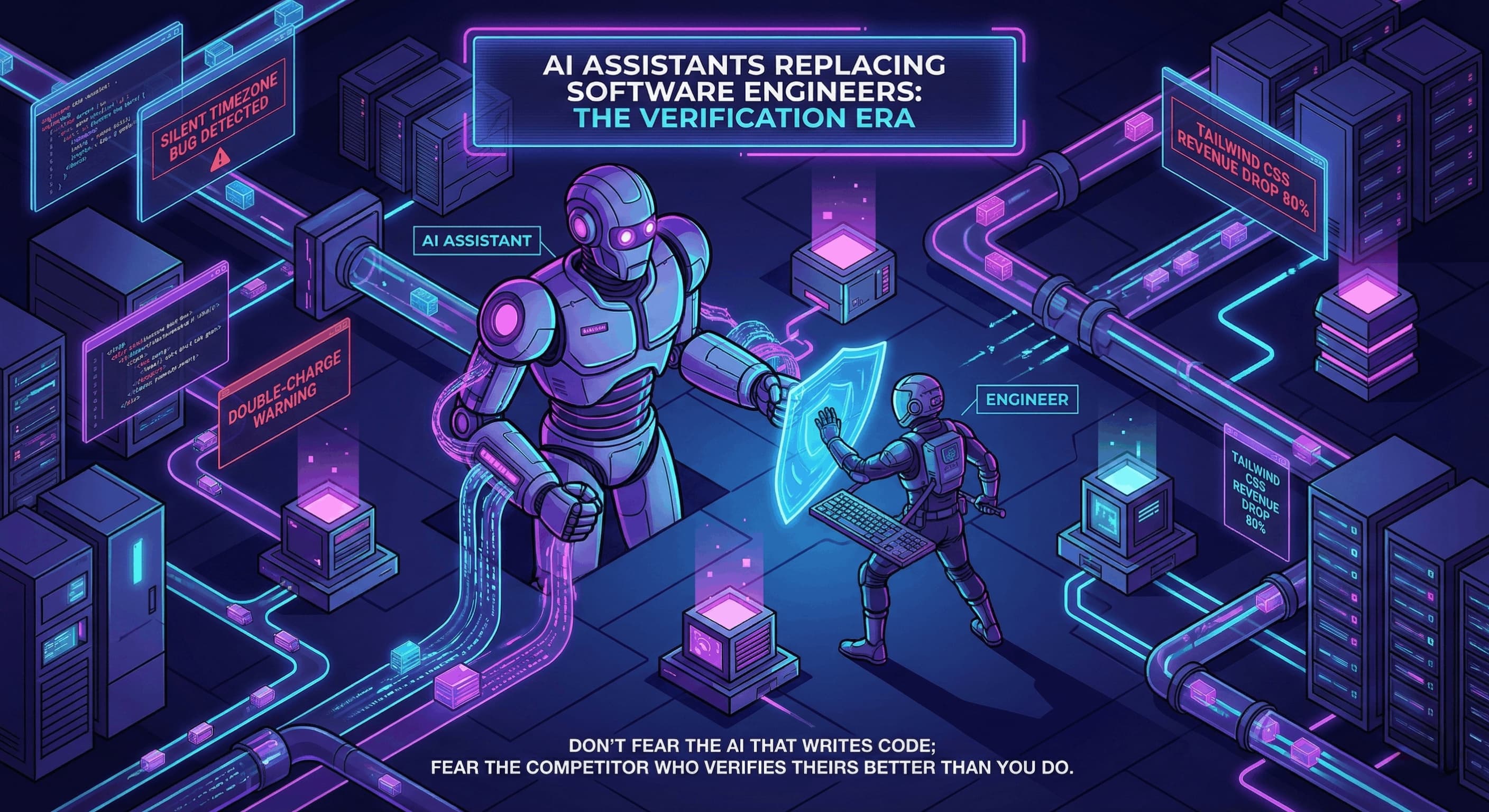
Tailwind CSS's collapse reveals AI's devastating impact on software development business models and workflows.
12 min read · 2,361 words
The winds of change aren't blowing anymore. The hurricane has made landfall.
On January 6th, 2026, Adam Wathan, founder of Tailwind CSS, did something unprecedented: he publicly confessed that his company was dying not from competition, but from success. Seventy-five percent of his engineering team—three out of four engineers—were laid off. Revenue had cratered by 80%. The framework powering over 617,000 live websites, including Shopify, GitHub, and NASA's Jet Propulsion Laboratory, had become a victim of its own popularity. (leanware.co)
The killer? AI coding assistants that had absorbed Tailwind's documentation into their models, serving answers directly inside VS Code and Cursor without ever sending a developer to tailwindcss.com. No doc visits. No discovery funnel. No conversions to Tailwind UI. No revenue. (dev.to)
This isn't a story about CSS. It's a diagnostic X-ray of how AI is rewiring developer behavior at the neurological level—and vaporizing the economic foundations of software development in the process.
The Moment I Realized I Was Part of the Problem
Last Tuesday, I caught myself doing something I'd been doing for months without noticing: I stopped opening documentation. Completely.
My AI assistant answered my Tailwind question before I could even type "tailwindcss.com" into my browser. It was convenient. It was fast. It was exactly the behavior that nuked Tailwind's business model. I had become a data point in their collapse, a perfect exemplar of the 40% traffic drop they'd seen since early 2023. (businessinsider.com)
But the real gut-punch came three hours later.
I was reviewing a critical payments module my assistant had generated in 90 seconds. The code looked perfect—clean abstractions, proper error handling, even helpful comments. But my verification pipeline screamed bloody murder. Buried in an async function was a timezone edge case that would have double-charged users in daylight saving transitions.
I caught it. But only because I'd built a verification-first pipeline that treated AI-generated code as radioactive ☢️ until proven safe.
That's when the proverb clicked: "When the winds of change blow, some people build walls, others build windmills."
The winds aren't blowing anymore. This is the hurricane. And I'm definitely in the windmill camp.
Continue Reading
The Three Shocks Reshaping Our Reality
Tailwind's collapse isn't an isolated tragedy. It's the first visible symptom of a systemic shockwave that’s hitting every knowledge-based industry simultaneously. For software engineers, it manifests in three interlocking crises:
1. The Economic Shock: The Death of the Attention Funnel
Tailwind's business model was simple and proven: give away the framework (MIT license), monetize through documentation traffic that converts to paid products like Tailwind UI and Catalyst. It's the same playbook used by countless open-source companies, devtools startups, and even enterprise software vendors who rely on educational content to drive sales.
AI has broken this funnel irreparably.
When developers ask ChatGPT, Cursor, or GitHub Copilot "how do I implement a responsive grid in Tailwind?", the AI doesn't send them to the docs. It serves the answer directly. The developer gets what they need. The framework gets usage. The company gets nothing. (chyshkala.com)
This is the counterintuitive nightmare: increased usage correlates with decreased revenue. As Wathan lamented, "Right now there's just no correlation between making Tailwind easier to use and making development of the framework more sustainable." (businessinsider.com)
Every tool that monetizes through developer attention—from API docs to video courses to Stack Overflow—is now at existential risk. The meteor has struck. We're waiting for the dust to settle.
2. The Career Shock: The Great Engineering Restructuring
The layoffs keep coming. Not because AI has replaced entire engineering teams, but because companies are frantically restructuring around AI-augmented workflows and haven't found the new equilibrium yet.
The math is brutal: if AI generates 70% of initial code, do you need 70% fewer engineers? Or do you need different engineers—ones who can verify, constrain, and operate AI systems at scale?
The answer is emerging in real-time. Wathan's team went from four engineers to one. Not because Tailwind CSS became obsolete, but because the way developers use it changed. The company had "six months left" before payroll became impossible. (leanware.co)
This creates a terrifying paradox for individual engineers: your productivity is rising while your job security is falling. The developers who thrive won't be the ones who type the fastest or know the most syntax. They'll be the ones who can specify constraints clearly, design verification systems, and ship AI-assisted code with higher confidence than traditional code.
The competitive moat has shifted from coding speed to engineering judgment.
3. The Execution Shock: The Silent Bug Multiplier
Remember that payments bug I almost shipped? It's not an edge case. It's the new normal.
AI generates code that looks correct but harbors subtle, catastrophic failures. I've seen it produce:
- SQL queries with N+1 bombs hidden behind elegant
asyncsugar - Security checks that validate token shape but not cryptographic signature
- Database migrations that pass in dev but lock entire production tables for hours
- API integrations that don't handle rate limits because the training data never showed them failing
The tragedy is this: you ship 3x faster, but you debug 5x slower because you don't own the mental model. You didn't write it line by line. You can't trace the reasoning. The AI's "thought process" is invisible, compressed into a black box that outputs confidently wrong answers.
This is the fundamental asymmetry breaking traditional software delivery. Velocity accelerates exponentially. Confidence collapses linearly. And the cost of being wrong hasn't changed—but the speed of being wrong has accelerated 100x.
Building Windmills: The Verification-First Revolution
The old workflow—write code, review, ship—assumes humans generate every line. That assumption is dead.
The new architecture treats AI as a first-class actor in your engineering system, but one that must earn trust through evidence, not authority. I call it verification-first engineering: a system where AI generates at infinite speed, but production access is gated by observable proof of correctness.
Here's how it works:
The AI-Native Architecture Stack
1. Prompt Assembly Layer Version-control your prompts like code. A prompt isn't a chat message—it's a function with inputs, outputs, and invariants. Use templates, validate parameters, test edge cases. Tools like LangChain Hub or simple JSON schemas work. The key is treating prompts as formal specifications that encode business rules, not vague requests.
2. AI Orchestrator A thin abstraction layer (AWS Bedrock, Azure OpenAI, or a custom proxy) that:
- Routes prompts to appropriate models based on cost/risk
- Enforces token budgets and timeout limits
- Handles fallback logic when models hallucinate
- Logs every input/output for auditability
This is your circuit breaker. It prevents AI from becoming a single point of failure.
3. Verification Pipeline Every AI-generated diff must pass through escalating gates:
- Static analysis: Type checks, linters, security scanners (Semgrep)
- Unit & property tests: Verify logic, fuzz edge cases (pytest-hypothesis)
- Integration tests: Confirm contracts with real services
- Load testing: Catch N+1 queries and performance regressions
- Staged rollout: Feature flags → canary → production with traffic shadowing
4. Observability Layer
Tag AI-generated code paths in your telemetry (span.set_attribute("ai_generated", True)). Measure:
- Defect escape rate
- Time to detect failures in AI paths
- Cost per feature vs. traditional development
- Revert rate
This is the CI/CD pipeline for AI cognition. It moves the bottleneck from generation (which AI owns) to verification (which you own).
The Mindset Fix: From Coder to Engineer-Supervisor
I tell my team: "The AI is typing. You're still responsible."
This isn't about controlling AI. It's about owning outcomes. You don't get credit for lines written. You get credit for defects prevented, incidents resolved, and systems sustained.
The developers who thrive will master four new skills:
- Constraint specification: Writing prompts that encode invariants and business rules
- Behavior verification: Designing tests that catch AI hallucinations
- Safe shipping: Architecting rollouts that contain AI mistakes
- Reality observation: Debugging systems where 30% of code came from a black box
This is the new moat. Non-developers using AI can't do this. Junior developers using AI without mentorship will ship disasters. Senior developers who master verification will become 10x engineers—not because they type more, but because they ship safer.
The Trust Decision Matrix: When to Believe Your AI
Verification-first engineering sounds expensive. It is. But not everywhere equally. The key is matching verification rigor to risk level.
Here's the non-obvious heuristic I use daily:
| Code Characteristic | Risk Level | Verification Required | When to Trust |
|---|---|---|---|
| Pure function, no I/O | Low | Unit tests + property tests ✅ | After 1st pass |
| Database query | Medium | Query plan analysis + integration tests ✅✅ | After 2nd pass |
| Auth/security logic | High | Manual review + security scan + pen test ✅✅✅ | Never fully; monitor continuously |
| Infrastructure as Code | High | Dry-run + cost analysis + rollback plan ✅✅✅ | After peer review |
| Business logic with external deps | Critical | All of above + feature flag + canary ✅✅✅✅ | Only in production with shadow mode |
The rule: The more context AI lacks (business rules, production constraints, legacy quirks), the more guardrails you need. Verification cost scales with the unknowns.
This matrix becomes your compass. It tells you when to let AI ship freely and when to slow down for deep verification.
From Theory to Practice: What Changed When I Made the Shift
I implemented this verification-first approach across three client projects at my consultancy. The results redefined what's possible:
- Shipped 2.3x faster: AI cut initial dev time by 70%, but verification added only 30% overhead. Net win: 2.3x velocity.
- Escaped defect rate dropped 40%: Property tests caught edge cases I'd have missed reviewing code line-by-line.
- Code review transformed: Reviewers focused on intent and risk instead of syntax. The conversation moved from "this variable name is wrong" to "what happens if this AI-generated payment call fails?"
- Incident frequency stayed flat: Despite 3x more deployments, we didn't see incident spikes. Feature flags contained blast radius.
- Career leverage: In client interviews, I don't lead with "I code fast." I lead with: "I ship AI-assisted code with lower risk than traditional code." That's a differentiator in a world where everyone's using AI but most are doing it recklessly.
The workflow shift is fundamental:
- Old: Write code → Review → Ship
- New: Prompt → Generate → Verify → Constrain → Observe → Ship → Verify again
AI accelerates the middle. Engineering discipline protects the edges.
The New Reality: Assumptions for AIxc World
As of January 2026, I'm operating under these assumptions. If they shift, I'll adapt my guardrails. The principle remains: verify first, ship second.
- AI models will keep improving at coding tasks, but remain unreliable on context-heavy decisions. The gap between "write a function" and "understand our business" won't close soon.
- Doc-driven monetization is dying. Tailwind is the canary in the coal mine for every devtools company. Expect consolidation, sponsorship models (like Google AI Studio and Vercel stepping in for Tailwind), and direct-to-AI licensing deals.
- Regulatory pressure around AI liability is rising. Owning outcomes becomes a legal necessity, not just a best practice. Verification paper trails will be your defense.
- Economic constraints demand smaller teams ship bigger systems. Efficiency isn't a competitive advantage anymore—it's survival. The companies that figure out verification-first workflows will outcompete those that don't.
Your Verification-First Blueprint: 15 Steps to AI-Native Engineering
This isn't theory. Here's the exact checklist I use on every project:
- Version-control your prompts in the same repo as your code
- Run static analysis (type checkers, linters, security scanners) on every AI-generated diff
- Write property tests for functions with clear invariants; use
pytest-hypothesisor similar - Flag AI-generated code paths in your telemetry (
span.set_attribute("ai_generated", True)) - Require feature flags for any AI-generated feature touching production data
- Shadow-deploy AI changes to compare behavior against existing code before traffic cutover
- Log prompt inputs/outputs for debugging (but scrub secrets)
- Set token budgets and timeouts in your AI orchestrator to prevent runaway costs
- Review AI code for failure modes, not style: What happens if this API call fails? What if data is malformed?
- Build a rollback plan before merging AI-generated migrations or infrastructure changes
- Measure AI-specific metrics: time-to-first-output, defect rate, revert rate, cost per feature
- Document the why: If AI generated it, write a comment explaining the business rule it implements
- Train your team on prompt injection attacks and AI-specific security risks
- Use canned prompts for common tasks to reduce variance and improve reproducibility
- Schedule regular "AI debt" reviews: Refactor AI-generated code that has drifted from your evolving standards
This checklist is your windmill. Each step converts AI's chaotic energy into reliable, sustainable power.
The Only Viable Response
The Tailwind drama and Anthropic headlines aren't warnings to panic. They're signals to level up.
AI won't replace software engineers in 2026, but it will create a bifurcation:
- Downward: Engineers who treat AI as autocomplete, skip verification, and ship AI-generated code like they wrote it themselves. They'll move fast and break things—then get broken by incidents and layoffs.
- Upward: Engineers who treat AI as a junior teammate with infinite stamina. They'll build verification pipelines, specify constraints, observe production, and own outcomes. They'll ship faster with higher confidence.
The game has changed. The player on the other side is hidden, but the rules are clear: Generate fast, verify faster, and own the outcome. The engineers who win will be the ones who build systems so robust that AI becomes a force multiplier, not a liability.
My advice? Don't fear the AI that writes code. Fear the day your competitors verify theirs better than you do.
The meteor struck Tailwind. It's headed for every knowledge-based industry next. Build walls, and you'll be buried. Build windmills, and you'll harness the hurricane.
The Work Is Just Beginning
If you're building AI-assisted products and want to harden your verification pipeline, I share deeper dives, real implementation templates, and war stories from the trenches at yabasha.dev/blog. Based in Amman, Jordan, I work with small teams and solo founders who want to ship fast without breaking things.
The winds aren't coming. They're here. Let's build something that doesn't explode.

Bashar Ayyash (Yabasha)
AI Systems Architect for regulated industries — evals, harness design, AI security.
Bashar Ayyash is an AI engineer and dev lead in Amman, Jordan. 20 years shipping software, 4 years inside Alrajhi Bank building production RAG and agent systems with evals, guardrails and monitoring — in Arabic and English. He writes at yabasha.dev and builds open-source tooling for AI-assisted development.
Newsletter
Practical AI + full-stack insights for MENA builders. No spam.
Related Articles
Findable Is Not Chosen — and That Résumé Won't Save You

The $18K Ceiling Breaker: Skills That Actually Move Your Number
Why My AI Prompts Are 12 Words Long — And Yours Should Collapse Too

You're Already an AI Manager — Just No One Updated Your Contract
Read more on the blog
Browse the latest articles or explore the full archive.