You're Already an AI Manager — Just No One Updated Your Contract

A staff engineer realizes he's become an AI manager, directing agents and navigating legacy systems without a title update.
4 min read · 784 words
Yesterday I merged code. Today I merged 17 agent personalities.
Same chair, same Ctrl+S, wildly different output. Last week I spent 4 hours debugging a Laravel queue that swallowed 2,000 card-transaction jobs. Yesterday I spent 4 hours debugging Henry (our Slack AI) who swallowed 2,000 card-transaction descriptions. Same dopamine hit when the log turns green, different muscle memory.
Google VP Josh Woodward says "everyone is becoming a manager". Cute. In our Amman office we’ve skipped the ceremony and jumped straight to the messy part: directing agents that can spin 10,000 lines of boilerplate before I finish my Turkish coffee.
The org chart is now a wiring diagram
Three months ago I drew this on the whiteboard for our RBI compliance meeting:
Bashar (Staff Engineer)
├── Henry-Draft (slack bot, Node 20)
├── Henry-Security (OpenAI gpt-4-turbo)
├── Henry-OnCall (PagerDuty webhook glue)
└── Bashar-HandsOn (me, 40 % headroom)
CFO stared at it like I’d committed tax fraud. Then I showed the numbers: Henry-Draft wrote 62 % of last sprint’s API specs. Henry-Security caught a PCI regex that would have cost us SAR 450k in fines. I still typed the final git push, but only after three agents debated variable naming like junior devs fighting over tabs vs spaces.
Continue Reading
Taste is the new latency
Prompt engineering? Dead end. The compounding skill is taste — knowing when to let Henry hallucinate a JSON schema vs when to lock him in a straitjacket of Zod validation. Last Tuesday he spat out a transaction categorizer that classified “shawarma” as “charitable donation”. Funny until the regulator asks why Alrajhi’s risk engine thinks kebab shops are NGOs.
Same problem we had with offshore teams in 2012: garbage in, gospel out. Except now the offshore team is a 200-token context window and it never sleeps.
The trick is teaching taste at scale. We built a tiny Next.js app — internal codename TasteLinter — that scores each agent output on three axes:
- Compliance (does it violate SAMA circular 12/2024?)
- Risk (could this query expose PII?)
- Aesthetics (is the generated Laravel resource route actually RESTful?)
Fail any axis and the PR auto-blocks. Henry hates it. Our auditors love it. Same friction, new surface.
Voice is not the interface — narrative is
Woodward talks about Gemini Spark making voice the interface. That’s surface glitter. The real shift is narrative compression. I can say “build a refund flow that handles partial capture, partial void, and triggers an SMS to the cardholder in Arabic” and Henry spins a 120-line Laravel job, a React Native screen, and an SNS template. But if I misplace one adjective the whole thing compiles into a money-losing disaster.
Voice lowers the floor. Judgment raises the ceiling. There’s still no autocomplete for consequences.
Middle management without the salary bump
Here’s the dirty secret from 23 years of banking tech: middle management was always 80 % translation work. Translate business into Jira. Translate Jira into code. Translate code into outage reports. Agents just made the translation layer thinner.
I now spend my mornings curating instead of coding. Example: Henry generated a fraud-detection heuristic that looked brilliant until I realized it used customer email domain as a signal. In Jordan that flags every user with a .edu.jo address as high-risk — basically every university student in the country. One line of YAML, infinite reputational damage.
So I curate. I downgrade false positives the way I used to review pull requests. I leave comments like “use IFSC code, not email TLD” and Henry learns. The diff still shows my GitHub avatar, but the patch is 90 % machine-authored.
The gravity well of legacy
Nothing exposes the myth of “everyone is a manager” faster than a 2008 COBOL module sitting between your agents and the core banking switch. You can orchestrate Henry, Claude, and a fleet of GPT-4s, but if the mainframe only speaks 370-ASCII over MQ, you’re still stuck hand-rolling hex dumps at 2 a.m.
Legacy is the new middle management. It doesn’t report to you, but it approves all your vacation requests.
Promotion letter pending
HR hasn’t updated my title yet. Officially I’m Staff Software Engineer. Unofficially I manage:
- 3 AI agents (Henry variants)
- 2 offshore contractors (humans, for now)
- 1 legacy queue system (written in Java 6, immortal)
- 1 human intern (who thinks
git rebaseis dark magic)
Same paycheck, 4x the surface area for failure.
Your move
Look at your last week’s calendar. How many reviews were code vs agent behavior? If the ratio tips past 50 %, congratulations — you’re management. The org chart just didn’t send the memo.
So here’s my question: when performance-review season arrives, do we file the agents under direct reports or tools? Because right now they’re both, and the ambiguity is where the next outage hides.
#aiManagement #mideastFintech #agentOps

Bashar Ayyash (Yabasha)
AI Systems Architect for regulated industries — evals, harness design, AI security.
Bashar Ayyash is an AI engineer and dev lead in Amman, Jordan. 20 years shipping software, 4 years inside a regulated bank building production RAG and agent systems with evals, guardrails and monitoring — in Arabic and English. He writes at yabasha.dev and builds open-source tooling for AI-assisted development.
Newsletter
Practical AI + full-stack insights for MENA builders. No spam.
Related Articles

The $18K Ceiling Breaker: Skills That Actually Move Your Number

Every Engineer Is Now a Manager — Whether You Signed Up For It or Not
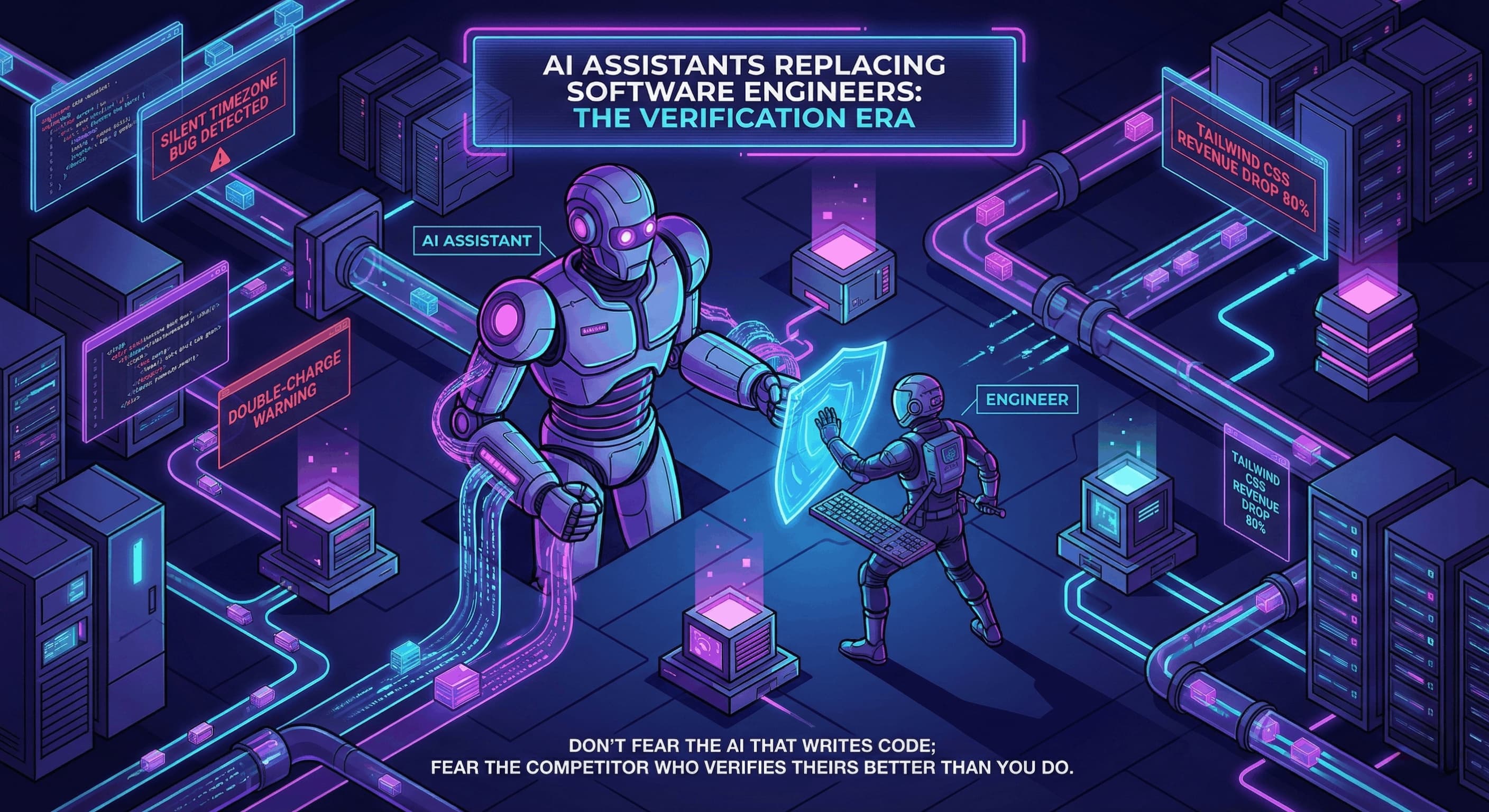
The Tailwind Tsunami: How a CSS Framework's Collapse Signals the End of Software Development as We Knew It

Findable Is Not Chosen — and That Résumé Won't Save You
Read more on the blog
Browse the latest articles or explore the full archive.