Leader Quick Note: How to Keep Your Team Survived in AI Era
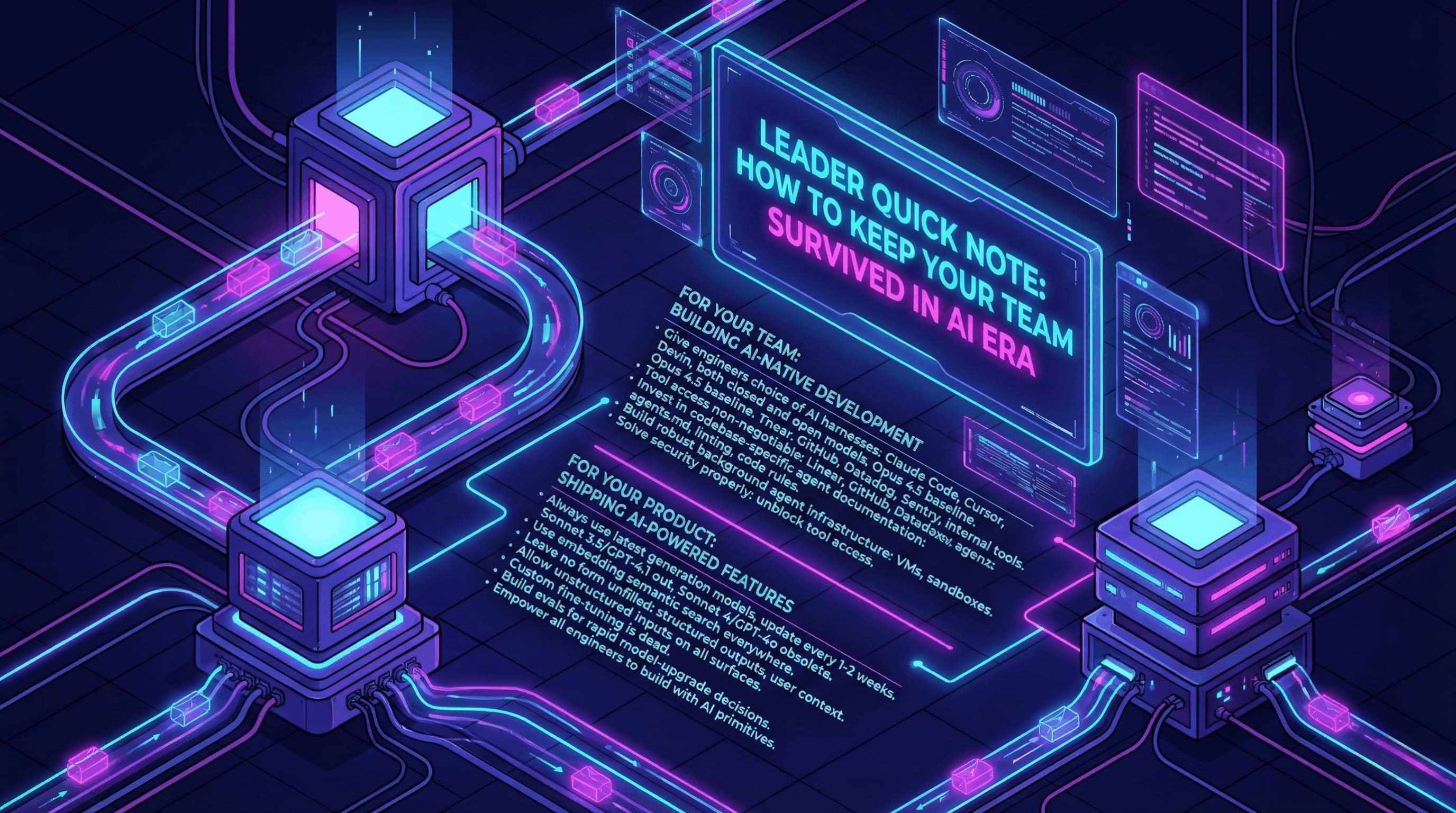
Learn how to keep your team competitive in the AI era with actionable strategies for development and product innovation.
3 min read · 500 words
The pace of change in AI is brutal, but here's what stings worse: seeing even FAANG companies lagging behind the frontier for no good reason. You are guaranteed to lose if you fall behind. This isn't about keeping up with the hype—it's about avoiding unforced errors that leave money and productivity on the table.
For Your Team: Building AI-Native Development
Give engineers their choice of AI harnesses. Every engineer should have access to coding agents with their preferred models and interfaces: Claude Code, Cursor, Devin, leveraging both closed and open models. Hearing that Meta engineers are forced to use Llama 4? That's a self-imposed limitation. Opus 4.5 is the baseline now.
Tool access is non-negotiable. Give your agents complete access to all dev tooling: Linear, GitHub, Datadog, Sentry, and any internal tools. If your agents are held back by lack of context, that's your failure, not theirs.
Invest in codebase-specific agent documentation. Stop complaining that agents "don't do X well." If that's your issue, try better prompting, agents.md, linting, and code rules. Tell them exactly how you want things done. Every manual edit you make is an opportunity for agent.md improvement.
Build robust background agent infrastructure. Get a full development stack running in VMs or sandboxes. Yes, it's hard to set up, but it pays dividends when engineers can run multiple agents in parallel. Code review will be your next bottleneck—get ahead of it.
Solve security properly. Stop being risk-averse and do what it takes to unblock tool access. Security theater that prevents AI adoption is an unforced error.
Continue Reading
For Your Product: Shipping AI-Powered Features
Always use the latest generation models. Move features off last-gen models immediately unless robust evals prove otherwise. This requires updating every 1-2 weeks. As jaredpalmer noted, GitHub Copilot mobile still offers code review with GPT-4.1 and Sonnet 3.5. You're leaving money on the table by staying on Sonnet 4 or GPT-4o.
Use embedding semantic search everywhere. Any general embedding model will outperform Levenshtein distance and fuzzy heuristics. This is table stakes.
Leave no form unfilled. Use structured outputs and available user context for best-effort pre-filling. Reduce friction ruthlessly.
Allow unstructured inputs on all surfaces. Forms are dead. Every product surface must accept freeform text and documents.
Custom fine-tuning is dead. Stop wasting 8 weeks on fine-tuning. The frontier moves too fast, costs are dropping too quickly, and better prompting gets you 90% of the way there. This will only become more true as instruction-following improves.
Build evals for rapid model-upgrade decisions. They don't need to be perfect—just good enough to compare models on a Pareto cost vs. performance plot. Most decisions become obvious.
Empower all engineers to build with AI. Build primitives to call models from any codebase: structured output endpoints, semantic similarity APIs, sandboxed code execution. Make AI a first-class building block.
What else belongs in this quick note? The frontier is moving—don't let unforced errors hold you back.

Bashar Ayyash (Yabasha)
AI Systems Architect for regulated industries — evals, harness design, AI security.
Bashar Ayyash is an AI engineer and dev lead in Amman, Jordan. 20 years shipping software, 4 years inside Alrajhi Bank building production RAG and agent systems with evals, guardrails and monitoring — in Arabic and English. He writes at yabasha.dev and builds open-source tooling for AI-assisted development.
Newsletter
Practical AI + full-stack insights for MENA builders. No spam.
Related Articles

Findable Is Not Chosen — and That Résumé Won't Save You

The $18K Ceiling Breaker: Skills That Actually Move Your Number

Why My AI Prompts Are 12 Words Long — And Yours Should Collapse Too
The Tailwind Tsunami: How a CSS Framework's Collapse Signals the End of Software Development as We Knew It
Read more on the blog
Browse the latest articles or explore the full archive.