Aqaba Isometric Diorama — Jordan in Miniature #25
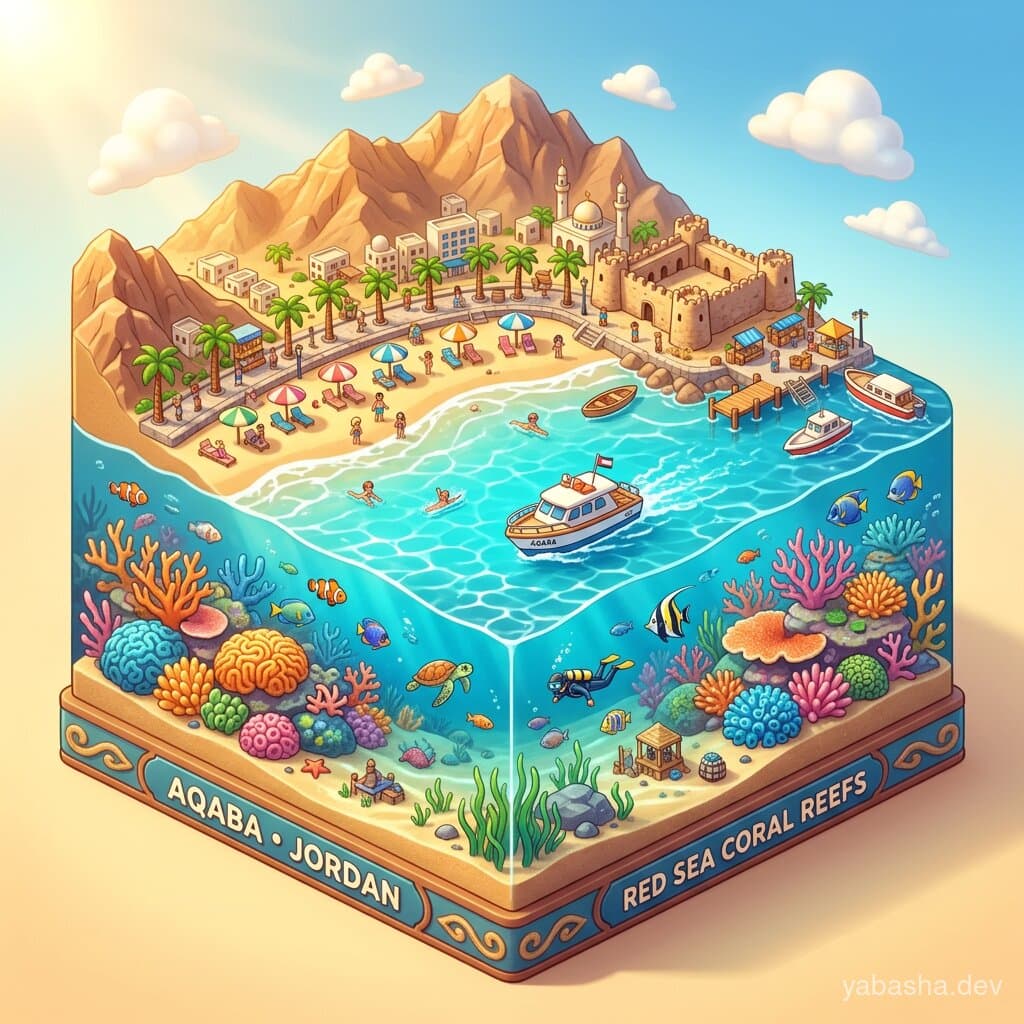
Aqaba's Red Sea shores rendered as an isometric 3D diorama — sun, coral, and turquoise water in miniature.
Bashar AyyashMay 25, 2026Updated June 27, 20263 min read562 words
Aqaba Isometric Diorama — Jordan in Miniature #25
Aqaba doesn't whisper. It slaps you with heat, salt, and color the second you step out of the car. Trying to cram that punch into a tiny isometric box sounds like a bad idea, which is exactly why I did it.
This scene sits on a rig I've been refining for twenty-five days straight: a 30-degree isometric camera angle locked in Blender, giving that dollhouse view where every roof, reef, and ripple gets equal billing. No heroic wide shots. No drone flexing. Just the place, folded into itself like a paper map that grew depth.

The geometry starts in Blender—hard surface modeling for the coastline, low-poly water planes, procedural shaders for the sand. Then I pull it into Procreate for texture work. People think digital painting died. It didn't. It just moved to smaller screens. I paint the coral streaks, the rust on the boats, the way concrete bleaches under Jordanian sun. That hand-work keeps the scene from looking like a video game asset dumped into a stock photo.
Here's where it gets spicy. I run the base render through FLUX, an open image generation model that doesn't hallucinate architecture into sci-fi nonsense. I use it like a smart fill tool, not a replacement for my brain. It handles the atmospheric haze, suggests color variations in the reef, and helps me iterate faster than staring at a render farm for six hours. The AI doesn't make the art. It sharpens the knife. There's a difference, and if you're using these tools to replace taste instead of accelerate it, you're building on sand.
The palette is deliberate theft from real life. That Red Sea turquoise isn't a default hex code; it's sampled from dive photos and memory. The sandstone browns lean warm, almost orange, because Aqaba's light bounces off desert rock and tints everything. I keep shadows purple-shifted, not black, because shadow color is where most 3D work goes to die. The lighting mimics golden hour—low, harsh, honest. Aqaba doesn't do soft overcast. The sun here is a physical weight, and the diorama lighting reflects that aggression.
Why Aqaba? Because culturally, it's Jordan's exhale. Amman is traffic and ambition. Petra is history with a capital H. Aqaba is where Jordanians go to remember we have a coastline, a window to the world that isn't a border crossing. It's scuba tanks and cardamom coffee at 2 AM, the smell of fish grilled over charcoal near the port. Putting it in miniature felt like building a shrine to the only place in the kingdom where the desert finally gives up and lets the sea win.
This daily project—Amman, Petra, Wadi Rum, now here—isn't a tourism board pitch. It's a stress test. Can I make my own country feel small enough to hold in one hand, but dense enough that locals nod and say "yeah, that's it"? Some days the tools fight me. Blender crashes. FLUX gives me a sky that looks like melted plastic. Some days they cooperate. Either way, the work gets done. Consistency beats inspiration. Every single time.
If you're still treating AI like either a magic wand or the enemy, maybe ask yourself: when was the last time you blamed your hammer for a crooked nail?

AUTHOR
Bashar Ayyash (Yabasha)
AI Engineer & Full-Stack Tech Lead
Expertise: 20+ years full-stack development. Specializing in architecting cognitive systems, RAG architectures, and scalable web platforms for the MENA region.
Newsletter
Practical AI + full-stack insights for MENA builders. No spam.
Related Articles

Graph Engineering Is Mostly Airflow With A New Coat Of Paint
August 4, 2026•10 min

The $18K Ceiling Breaker: Skills That Actually Move Your Number
July 9, 2026•6 min

Why My AI Prompts Are 12 Words Long — And Yours Should Collapse Too
July 9, 2026•7 min
Every Engineer Is Now a Manager — Whether You Signed Up For It or Not
July 9, 2026•7 min
Read more on the blog
Browse the latest articles or explore the full archive.